Peptide Quality: Relevance Of Third-party Recognition
Peptide Pureness Overview 98%, 99% & Research-grade Clarified Prg
Imaginative Proteomics is a relied on supplier of proteomics evaluation solutions. Many thanks to our outstanding scientists and powerful mass spectrometry platform, we off provides global consumer with detailed and expert peptide pureness analysis solution by utilizing RP-HPLC. If you have any kind of questions or specific demands, please feel free to contact us.
Peptide Pureness Levels Explained-- What 98%, 99%, And "Study Grade" Truly Indicate
- This is the quality where the boost most dramatically, because achieving that last 1-- 3% of pureness requires disposing of a considerable portion of the synthesized material.
- As an example, abbreviated peptides or chemically modified side-products might bind to targets or create side effects that confound your results.
- All products are sold for research study, lab, or logical purposes only, and are not for human use.
- Very couple of business study peptide providers supply MS/MS data on routine COAs-- it is usually scheduled for pharmaceutical-grade products and progressed study setups.
Peak Laboratory is a specific vendor of high-purity chemical reagents and peptides. All items provided are purely for in-vitro lab research and development utilize just. Check out flagship study peptides with batch-specific COA documents and HPLC/MS verification. Products are for in-vitro research laboratory research usage just and are not for human usage.
For a lot of viewers of a peptide novices' overview, "research-grade" is the world you operate in. It guarantees you that the peptide will certainly carry out well in experiments (assuming purity and identity are as specified), but it also brings the caution "Study Use Just." This expression is normally published on the vial or paperwork. It acts as a pointer and legal disclaimer that the item is not a healing or consumable.Sample Preparation
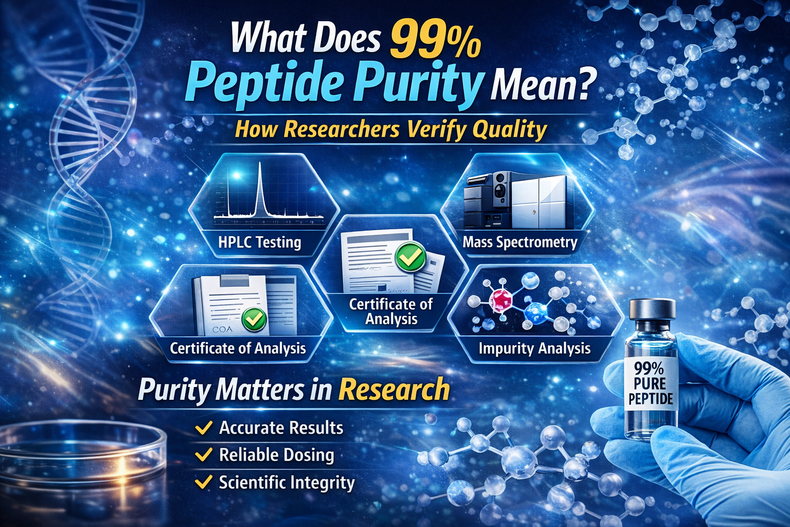
Not every application demands 99% pureness, and purification is a considerable part of peptide manufacturing expense. Trace quantities of solvents utilized throughout synthesis and filtration-- acetonitrile, dimethylformamide (DMF), dichloromethane-- can remain in the end product. These are Discover more here commonly existing at extremely low degrees in effectively produced peptides and are controlled by ICH Q3C standards for appropriate limits. If the target peptide's height accounts for 99.1% of the total peak area, the peptide is reported as 99.1% Go to the website pure by HPLC. Many trustworthy study peptide vendors use third-party labs; some conduct in-house testing with magazine of lab qualifications.In basic terms, a peptide provided as 95% pure consists mostly of the target peptide (95%), with the remaining ~ 5% made up of impurities. These contaminations can consist of points like shortened or abbreviated series, removal versions, oxidized residues, or various other small side-products from the synthesis procedure. Peptides are widely made use of in the medical appearances, cosmetics, and biomedical fields as a result of their special organic task and wide application potential. However, the high quality of peptide items straight affects their performance and safety and security, making accurate top quality testing services essential.

What Does Hplc-tested Mean?
The table below web links typical project objectives to practical analytical panels and the kind of choices they help sustain. Asparagine and glutamine residues can undertake deamidation, transforming the peptide's charge and hydrophobicity. Deamidation is one reason storage space problems issue, particularly after a peptide has been reconstituted. Every item we lug is lab-tested and verified by third-party companions, so researchers know precisely what they're collaborating with. Peptides containing methionine or cysteine residues are susceptible to oxidation. Methionine can be oxidized to methionine sulfoxide; cysteine can form unwanted disulfide bonds or be oxidized to sulfinic or sulfonic acid derivatives.